| |
February 2021 |
PX3 2016: Silver Award
Andrea Paolini Merlo was Awarded Silver in the PX3 2016 Competition with the "LyingHand" photo.
PEOPLE'S CHOICE.
PX3 PRIX DE LA PHOTOGRAPHIE PARIS
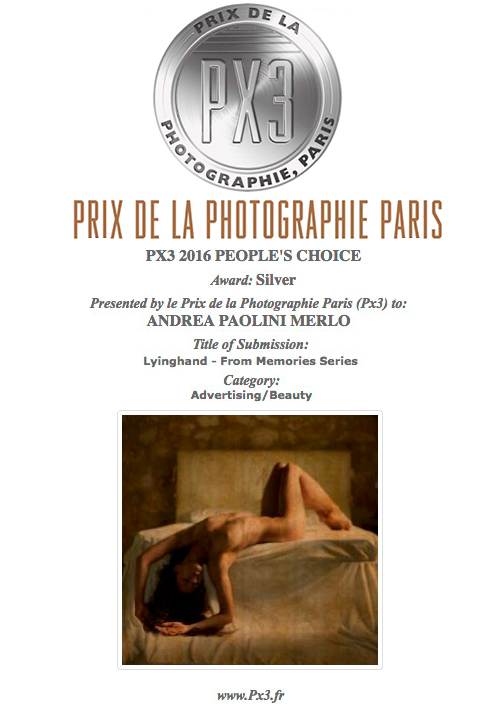
ANDREA PAOLINI MERLO OF HUNGARY WAS AWARDED SECOND PRIZE BY PEOPLE'S CHOICE IN THE PX3 2016 COMPETITION.
The people selected PX3 2016’s winners from thousands of photography entries from over 85 countries.
Px3
is juried by top international decision-makers in the photography
industry: Carol Johnson, Curator of Photography of Library of Congress,
Washington D.C.; Gilles Raynaldy, Director of Purpose, Paris; Viviene
Esders, Expert près la Cour d'Appel de Paris; Mark Heflin, Director of
American Illustration + American Photography, New York; Sara Rumens,
Lifestyle Photo Editor of Grazia Magazine, London; Françoise Paviot,
Director of Galerie Françoise Paviot, Paris; Chrisitine Ollier, Art
Director of Filles du Calvaire, Paris; Natalie Johnson, Features Editor
of Digital Photographer Magazine, London; Natalie Belayche, Director of
Visual Delight, Paris; Kenan Aktulun, VP/Creative Director of Digitas,
New York; Chiara Mariani, Photo Editor of Corriere della Sera Magazine,
Italy; Arnaud Adida, Director of Acte 2 Gallery/Agency, Paris; Jeannette
Mariani, Director of 13 Sévigné Gallery, Paris; Bernard Utudjian,
Director of Galerie Polaris, Paris; Agnès Voltz, Director of Chambre
Avec Vues, Paris; and Alice Gabriner, World Picture Editor of Time
Magazine, New York.
ABOUT Px3: The "Prix de la Photographie Paris" (Px3) strives to
promote the appreciation of photography, to discover emerging talent,
and introduce photographers from around the world to the artistic
community of Paris. Winning photographs from this competition are
exhibited in a high-profile gallery in Paris and published in the
high-quality, full-color Px3 Annual Book.
|
|
October 2016 |
PX3 2016: Silver Award
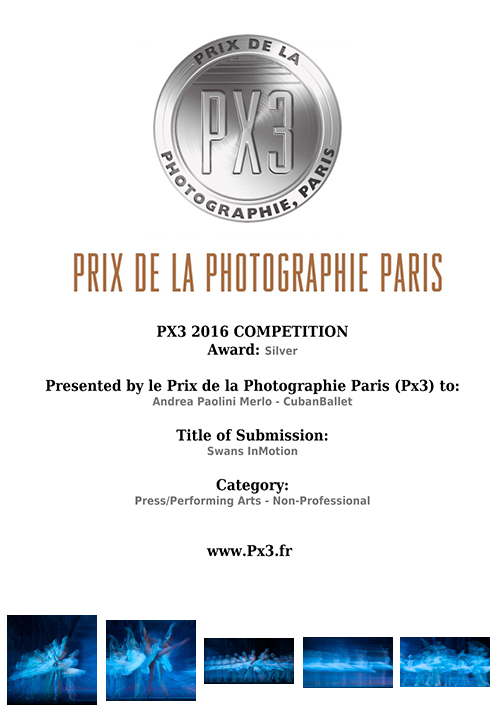
Andrea Paolini Merlo was Awarded Silver and Bronze in 2 categories in the PX3 2016 International Photographic Competition with the "Swans InMotion" series.
PX3 PRIX DE LA PHOTOGRAPHIE PARIS
WINNER OF PX3, Prix de la Photographie Paris
ANDREA PAOLINI MERLO WAS AWARDED SECOND PRIZE IN THE
PX3 2016 COMPETITION.
PARIS, FRANCE
PRIX DE LA PHOTOGRAPHIE PARIS (PX3) ANNOUNCES WINNERS OF PX3 2016 COMPETITION.
Andrea Paolini Merlo was Awarded: Second Prize in category Press for the entry entitled, "
Swans InMotion ." The jury selected PX3 2016’s winners from thousands of photography entries from over 85
countries.
Px3 is juried by top international decision-makers in the photography industry: Carol Johnson, Curator of Photography
of Library of Congress, Washington D.C.; Gilles Raynaldy, Director of Purpose, Paris; Viviene Esders, Expert près la Cour
d'Appel de Paris; Mark Heflin, Director of American Illustration + American Photography, New York; Sara Rumens,
Lifestyle Photo Editor of Grazia Magazine, London; Françoise Paviot, Director of Galerie Françoise Paviot, Paris;
Chrisitine Ollier, Art Director of Filles du Calvaire, Paris; Natalie Johnson, Features Editor of Digital Photographer
Magazine, London; Natalie Belayche, Director of Visual Delight, Paris; Kenan Aktulun, VP/Creative Director of Digitas,
New York; Chiara Mariani, Photo Editor of Corriere della Sera Magazine, Italy; Arnaud Adida, Director of Acte 2
Gallery/Agency, Paris; Jeannette Mariani, Director of 13 Sévigné Gallery, Paris; Bernard Utudjian, Director of Galerie
Polaris, Paris; Agnès Voltz, Director of Chambre Avec Vues, Paris; and Alice Gabriner, World Picture Editor of Time
Magazine, New York.
ABOUT Px3:
The "Prix de la Photographie Paris" (Px3) strives to promote the appreciation of photography, to discover emerging
talent, and introduce photographers from around the world to the artistic community of Paris. Winning photographs
from this competition are exhibited in a high-profile gallery in Paris and published in the high-quality, full-color Px3
Annual Book.
Visit http://px3.fr
For Press Inquiries, Contact:
Press@px3.fr
|
|
November 2015 |
IPA 2015: 3rd Place
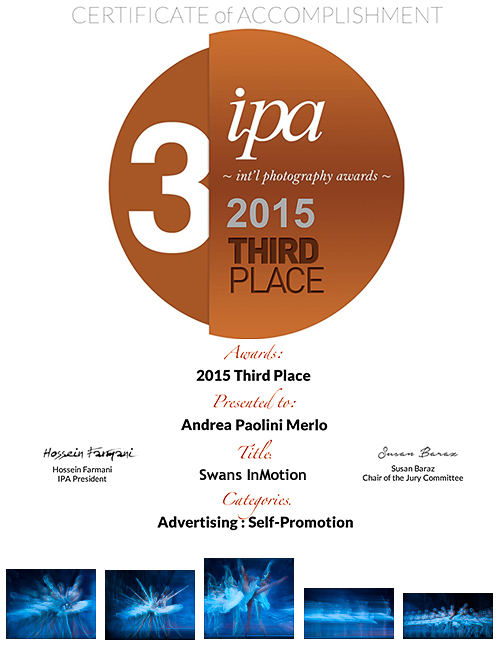
Andrea Paolini Merlo was Awarded 3rd Place in the IPA 2015 Competition.
ipa ~ int'l photography awards ~
International Photography Awards Announces Category Winners of the 2015 Competition!
This year, The International Photography Awards received 17815 of submissions from over 153 countries, and is pleased to declare that Andrea Paolini Merlo was awarded 3rd place in Advertising-Self-Promotion for the winning entry Swans InMotion.
About the International Photography Awards
The International Photography Awards conducts an annual competition for professional, non-professional, and student photographers on a global scale, creating one of the most ambitious and comprehensive competitions in the photography world today. Each year, the International Photography Awards (IPA) invites passionate photographers, to compete for the title of Photographer of the Year, Discovery of the Year and Deeper Perspective Photographer of the Year. A board of esteemed professionals in the field juries the competition: curators, photo editors, gallery owners, art directors, and other luminaries from the international photography community. The awards includes a Lucie Statue and cash prizes totaling over $20,000, exhibition and publication opportunities. www.photoawards.com
About the Lucie Awards
The Lucie Awards is the annual event honoring the greatest achievements in photography. The photography community from countries around the globe will pay tribute to the most outstanding photography achievements presented at the Gala Awards ceremony. Each year, the Advisory Board nominates deserving individuals across a variety of categories who will be honored during the Lucie Awards ceremony. Once the nominations have been received, the votes are tallied and an honoree in each category is identified. The honorees are pre-announced months before the Lucie Awards. The Lucie Awards are a signature program of Lucie Foundation. www.lucieawards.com
|
|
June 2015 |
PX3 2015: First Price People's Choice
Andrea Paolini Merlo was Awarded First Price People's Choice in the PX3 2015 Competition.
PX3 PRIX DE LA PHOTOGRAPHIE PARIS
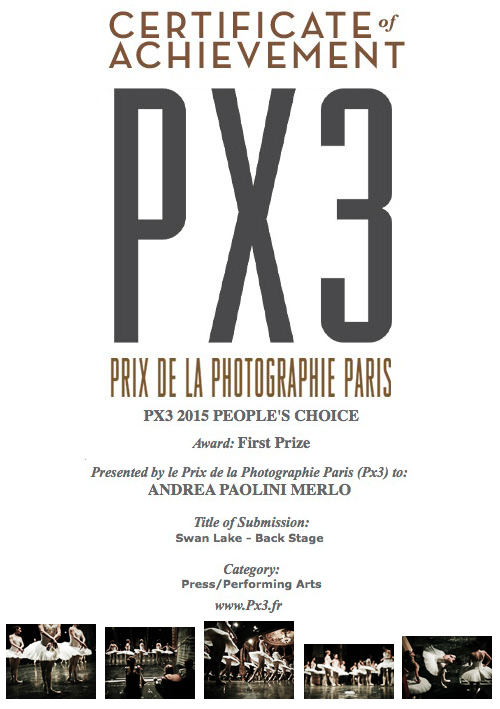
ANDREA PAOLINI MERLO OF HUNGARY WAS AWARDED FIRST PRIZE PEOPLE'S CHOICE IN THE PX3 2015 COMPETITION.
PARIS, FRANCE PRIX DE LA PHOTOGRAPHIE PARIS (PX3) ANNOUNCES WINNERS OF PX3 2015 COMPETITION.
Andrea
Paolini Merlo of Hungary was Awarded: First Prize People's Choice in category Press for
the entry entitled, " Swan Lake - Back Stage ." The PEOPLE selected PX3
2015’s winners from thousands of photography entries from over 85
countries.
Px3 is juried by top international decision-makers in the
photography industry: Carol Johnson, Curator of Photography of Library
of Congress, Washington D.C.; Gilles Raynaldy, Director of Purpose,
Paris; Viviene Esders, Expert près la Cour d'Appel de Paris; Mark
Heflin, Director of American Illustration + American Photography, New
York; Sara Rumens, Lifestyle Photo Editor of Grazia Magazine, London;
Françoise Paviot, Director of Galerie Françoise Paviot, Paris;
Chrisitine Ollier, Art Director of Filles du Calvaire, Paris; Natalie
Johnson, Features Editor of Digital Photographer Magazine, London;
Natalie Belayche, Director of Visual Delight, Paris; Kenan Aktulun,
VP/Creative Director of Digitas, New York; Chiara Mariani, Photo Editor
of Corriere della Sera Magazine, Italy; Arnaud Adida, Director of Acte 2
Gallery/Agency, Paris; Jeannette Mariani, Director of 13 Sévigné
Gallery, Paris; Bernard Utudjian, Director of Galerie Polaris, Paris;
Agnès Voltz, Director of Chambre Avec Vues, Paris; and Alice Gabriner,
World Picture Editor of Time Magazine, New York.
ABOUT Px3: The
"Prix de la Photographie Paris" (Px3) strives to promote the
appreciation of photography, to discover emerging talent, and introduce
photographers from around the world to the artistic community of Paris.
Winning photographs from this competition are exhibited in a
high-profile gallery in Paris and published in the high-quality,
full-color Px3 Annual Book.
|
|
June 2015 |
PX3 2015: Gold Award
Andrea Paolini Merlo was Awarded Gold in the PX3 2015 Competition.
PX3 PRIX DE LA PHOTOGRAPHIE PARIS
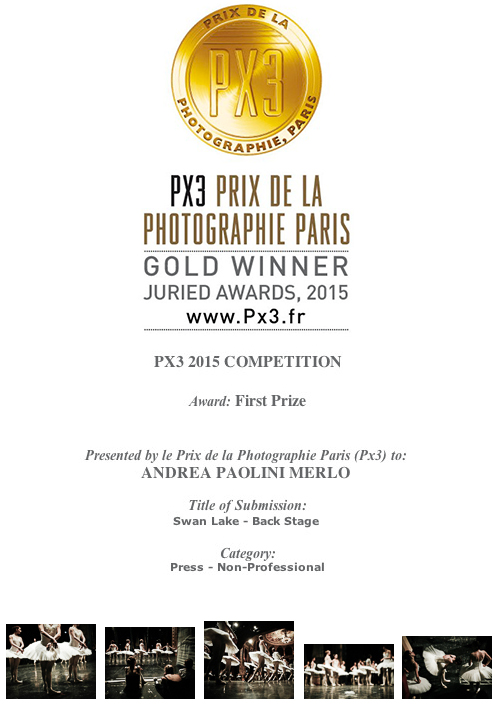
ANDREA PAOLINI MERLO OF HUNGARY WAS AWARDED FIRST PRIZE IN THE PX3 2015 COMPETITION.
PARIS, FRANCE PRIX DE LA PHOTOGRAPHIE PARIS (PX3) ANNOUNCES WINNERS OF PX3 2015 COMPETITION.
Andrea Paolini Merlo of Hungary was Awarded: First Prize in category Press for the entry entitled, " Swan Lake - Back Stage ." The jury selected PX3 2015’s winners from thousands of photography entries from over 85 countries.
Px3 is juried by top international decision-makers in the photography industry: Carol Johnson, Curator of Photography of Library of Congress, Washington D.C.; Gilles Raynaldy, Director of Purpose, Paris; Viviene Esders, Expert près la Cour d'Appel de Paris; Mark Heflin, Director of American Illustration + American Photography, New York; Sara Rumens, Lifestyle Photo Editor of Grazia Magazine, London; Françoise Paviot, Director of Galerie Françoise Paviot, Paris; Chrisitine Ollier, Art Director of Filles du Calvaire, Paris; Natalie Johnson, Features Editor of Digital Photographer Magazine, London; Natalie Belayche, Director of Visual Delight, Paris; Kenan Aktulun, VP/Creative Director of Digitas, New York; Chiara Mariani, Photo Editor of Corriere della Sera Magazine, Italy; Arnaud Adida, Director of Acte 2 Gallery/Agency, Paris; Jeannette Mariani, Director of 13 Sévigné Gallery, Paris; Bernard Utudjian, Director of Galerie Polaris, Paris; Agnès Voltz, Director of Chambre Avec Vues, Paris; and Alice Gabriner, World Picture Editor of Time Magazine, New York.
ABOUT Px3: The "Prix de la Photographie Paris" (Px3) strives to promote the appreciation of photography, to discover emerging talent, and introduce photographers from around the world to the artistic community of Paris. Winning photographs from this competition are exhibited in a high-profile gallery in Paris and published in the high-quality, full-color Px3 Annual Book.
|
|
June 2015 |
PX3 2015: Silver Award
Andrea Paolini Merlo was Awarded Silver in 2 different categories in the PX3 2015 Competition with the "Simply Ballet Dancers" series.
PX3 PRIX DE LA PHOTOGRAPHIE PARIS
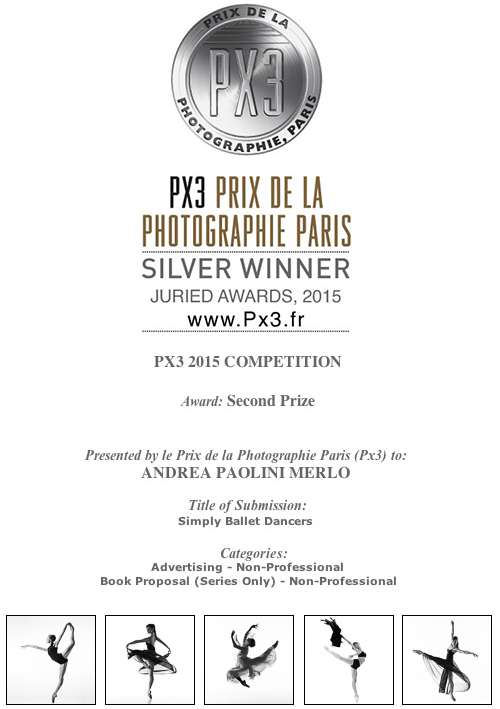
ANDREA PAOLINI MERLO OF HUNGARY WAS AWARDED SECOND PRIZE IN THE PX3 2015 COMPETITION.
PARIS, FRANCE PRIX DE LA PHOTOGRAPHIE PARIS (PX3) ANNOUNCES WINNERS OF PX3 2015 COMPETITION.
Andrea Paolini Merlo of Hungary was Awarded: Second Prize in categories Book Proposal (Series Only) and Advertising for the entry entitled, " Simply Ballet Dancers". The jury selected PX3 2015’s winners from thousands of photography entries from over 85 countries.
Px3 is juried by top international decision-makers in the photography industry: Carol Johnson, Curator of Photography of Library of Congress, Washington D.C.; Gilles Raynaldy, Director of Purpose, Paris; Viviene Esders, Expert près la Cour d'Appel de Paris; Mark Heflin, Director of American Illustration + American Photography, New York; Sara Rumens, Lifestyle Photo Editor of Grazia Magazine, London; Françoise Paviot, Director of Galerie Françoise Paviot, Paris; Chrisitine Ollier, Art Director of Filles du Calvaire, Paris; Natalie Johnson, Features Editor of Digital Photographer Magazine, London; Natalie Belayche, Director of Visual Delight, Paris; Kenan Aktulun, VP/Creative Director of Digitas, New York; Chiara Mariani, Photo Editor of Corriere della Sera Magazine, Italy; Arnaud Adida, Director of Acte 2 Gallery/Agency, Paris; Jeannette Mariani, Director of 13 Sévigné Gallery, Paris; Bernard Utudjian, Director of Galerie Polaris, Paris; Agnès Voltz, Director of Chambre Avec Vues, Paris; and Alice Gabriner, World Picture Editor of Time Magazine, New York.
ABOUT Px3: The "Prix de la Photographie Paris" (Px3) strives to promote the appreciation of photography, to discover emerging talent, and introduce photographers from around the world to the artistic community of Paris. Winning photographs from this competition are exhibited in a high-profile gallery in Paris and published in the high-quality, full-color Px3 Annual Book.
|
|
June 2015 |
PX3 2015: Silver Award
Andrea Paolini Merlo was Awarded Silver in the PX3 2015 Competition with the "Folded With Elegance" photo.
PX3 PRIX DE LA PHOTOGRAPHIE PARIS
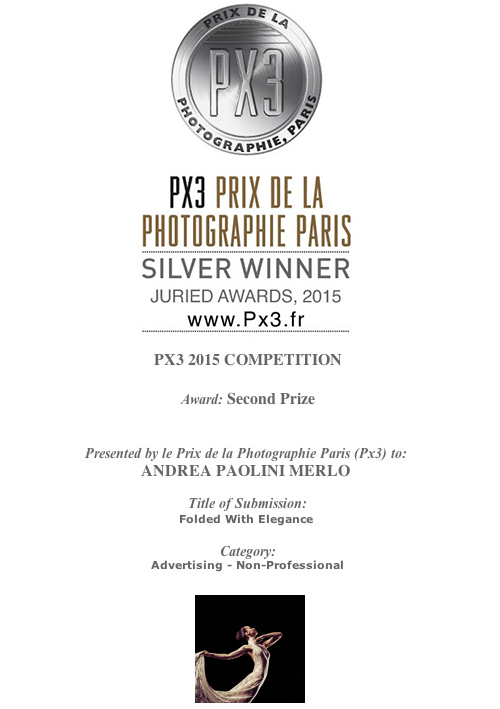
ANDREA PAOLINI MERLO OF HUNGARY WAS AWARDED SECOND PRIZE IN THE PX3 2015 COMPETITION.
PARIS, FRANCE PRIX DE LA PHOTOGRAPHIE PARIS (PX3) ANNOUNCES WINNERS OF PX3 2015 COMPETITION.
Andrea Paolini Merlo of Hungary was Awarded: Second Prize in category Advertising for the entry entitled, " Folded With Elegance ." The jury selected PX3 2015’s winners from thousands of photography entries from over 85 countries.
Px3 is juried by top international decision-makers in the photography industry: Carol Johnson, Curator of Photography of Library of Congress, Washington D.C.; Gilles Raynaldy, Director of Purpose, Paris; Viviene Esders, Expert près la Cour d'Appel de Paris; Mark Heflin, Director of American Illustration + American Photography, New York; Sara Rumens, Lifestyle Photo Editor of Grazia Magazine, London; Françoise Paviot, Director of Galerie Françoise Paviot, Paris; Chrisitine Ollier, Art Director of Filles du Calvaire, Paris; Natalie Johnson, Features Editor of Digital Photographer Magazine, London; Natalie Belayche, Director of Visual Delight, Paris; Kenan Aktulun, VP/Creative Director of Digitas, New York; Chiara Mariani, Photo Editor of Corriere della Sera Magazine, Italy; Arnaud Adida, Director of Acte 2 Gallery/Agency, Paris; Jeannette Mariani, Director of 13 Sévigné Gallery, Paris; Bernard Utudjian, Director of Galerie Polaris, Paris; Agnès Voltz, Director of Chambre Avec Vues, Paris; and Alice Gabriner, World Picture Editor of Time Magazine, New York.
ABOUT Px3: The "Prix de la Photographie Paris" (Px3) strives to promote the appreciation of photography, to discover emerging talent, and introduce photographers from around the world to the artistic community of Paris. Winning photographs from this competition are exhibited in a high-profile gallery in Paris and published in the high-quality, full-color Px3 Annual Book.
|
|
June 2015 |
PX3 2015: Silver Award
Andrea Paolini Merlo was Awarded also Bronze in the PX3 2015 Competition with the "Simply Ballet Dancers" series.
PX3 PRIX DE LA PHOTOGRAPHIE PARIS
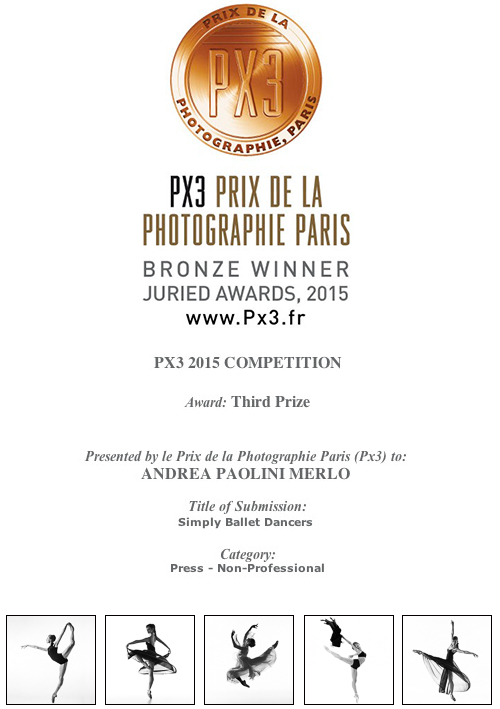
ANDREA PAOLINI MERLO OF HUNGARY WAS AWARDED THIRD PRIZE IN THE PX3 2015 COMPETITION.
PARIS, FRANCE PRIX DE LA PHOTOGRAPHIE PARIS (PX3) ANNOUNCES WINNERS OF PX3 2015 COMPETITION.
Andrea Paolini Merlo of Hungary was Awarded: Third Prize in category Press for the entry entitled, " Simply Ballet Dancers ." The jury selected PX3 2015’s winners from thousands of photography entries from over 85 countries.
Px3 is juried by top international decision-makers in the photography industry: Carol Johnson, Curator of Photography of Library of Congress, Washington D.C.; Gilles Raynaldy, Director of Purpose, Paris; Viviene Esders, Expert près la Cour d'Appel de Paris; Mark Heflin, Director of American Illustration + American Photography, New York; Sara Rumens, Lifestyle Photo Editor of Grazia Magazine, London; Françoise Paviot, Director of Galerie Françoise Paviot, Paris; Chrisitine Ollier, Art Director of Filles du Calvaire, Paris; Natalie Johnson, Features Editor of Digital Photographer Magazine, London; Natalie Belayche, Director of Visual Delight, Paris; Kenan Aktulun, VP/Creative Director of Digitas, New York; Chiara Mariani, Photo Editor of Corriere della Sera Magazine, Italy; Arnaud Adida, Director of Acte 2 Gallery/Agency, Paris; Jeannette Mariani, Director of 13 Sévigné Gallery, Paris; Bernard Utudjian, Director of Galerie Polaris, Paris; Agnès Voltz, Director of Chambre Avec Vues, Paris; and Alice Gabriner, World Picture Editor of Time Magazine, New York.
ABOUT Px3: The "Prix de la Photographie Paris" (Px3) strives to promote the appreciation of photography, to discover emerging talent, and introduce photographers from around the world to the artistic community of Paris. Winning photographs from this competition are exhibited in a high-profile gallery in Paris and published in the high-quality, full-color Px3 Annual Book.
|
|
July 2014 |
IPA 2014: Honorable Mentions
Andrea Paolini Merlo was Awarded in the IPA 2014 Competition with 4 Honorable Mentions in 4 different categories for the "Swan Lake Rehearsal" entitled photo series.
ipa ~ int'l photography awards ~

International Photography Awards Announces Category Winners of the 2014 Competition.
On September 30, 2014 the International Photography Awards competition (IPA) announced Category Winners of 2014 Competition!
This year, IPA received over 27000 submissions from 104 countries across the globe and is pleased to declare that Andrea Paolini Merlo was awarded Honorable Mention in 4 different Categories ("Advertising - Self-Promotion", "Editorial", "Events - Traditions and Cultures" and "People - Life Style") in the 2014 International Photography Awards (IPA) Competition for the winning entry "Swan Lake Rehearsal".
About the International Photography Awards
The International Photography Awards conducts an annual competition for professional, non-professional, and student photographers on a global scale, creating one of the most ambitious and comprehensive competitions in the photography world today. Each year, the International Photography Awards (IPA) invites passionate photographers, to compete for the title of Photographer of the Year, Discovery of the Year and Deeper Perspective Photographer of the Year. A board of esteemed professionals in the field juries the competition: curators, photo editors, gallery owners, art directors, and other luminaries from the international photography community. The awards includes a Lucie Statue and cash prizes totaling over $20,000, exhibition and publication opportunities.
|
|
March 2013 |
One Eyeland Photography Award 2012: Photographer Of The Year Award
Andrea Paolini Merlo was Awarded Silver as Photographer Of The Year in the Fine Art (Amateur) category in the ONE EYELAND Photography Award 2012.
His Photos from the In Motion series were also awarded Silver in 3 different categories: Fine Art - Abstract, Fine Art - Other, Special - Others.
ONE EYELAND

A distinguished panel of the most seasoned international photographers has been handpicked to oversee the rigorous judging process at the One Eyeland Photography Awards.
Unlike other award shows that have a motley mix of photographers, art directors, art buyers and publishers, the One Eyeland jury has only specialist photographers who've been there and done that. So all entries will be evaluated only by practitioners of the craft.
Another interesting facet is that all the members of the jury will be flown down to India to spend a few days to physically see all the pieces and then they will be voting on all entries in all categories applying a consistent set of parameters. Our roster of eminent judges includes: Andreas Smetana, Christophe Gilbert, Christopher Wilson, Erik Almas and Sharad Haksar.
|
|
August 2012 |
IPA 2012: Honorable Mentions
Andrea Paolini Merlo was Awarded in the IPA 2012 Competition with 5 Honorable Mentions in 5 different categories for the "Visions" entitled photo series.
ipa ~ int'l photography awards ~
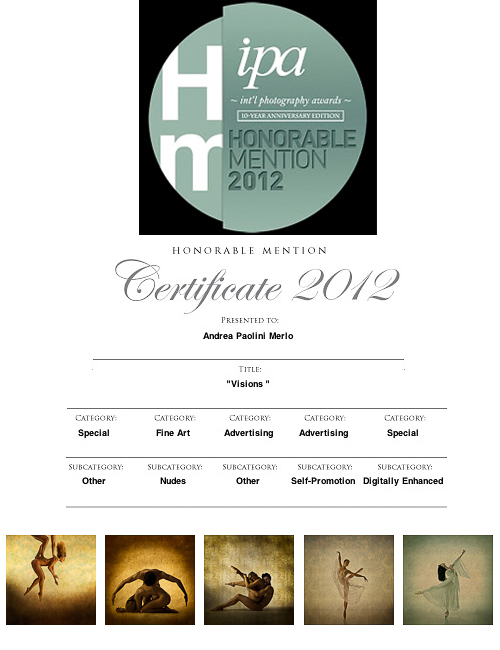
The 2012 International Photography Awards received nearly 18,000 submissions from 104 countries across the globe. IPA is a sister-effort of the Lucie Foundation, where the top three winners are announced at the annual Lucie Awards gala ceremony. The Foundation's mission is to honor master photographers, to discover new and emerging talent and to promote the appreciation of photography. Since 2003, IPA has had the privilege and opportunity to acknowledge and recognize contemporary photographer's accomplishments in this specialized and highly visible competition. Visit www.photoawards.com
|
|
August 2012 |
IPA 2012: Honorable Mentions
Andrea Paolini Merlo was Awarded in the IPA 2012 Competition with 3 Honorable Mentions in 3 different categories for the "Creation 01" entitled photo.
ipa ~ int'l photography awards ~
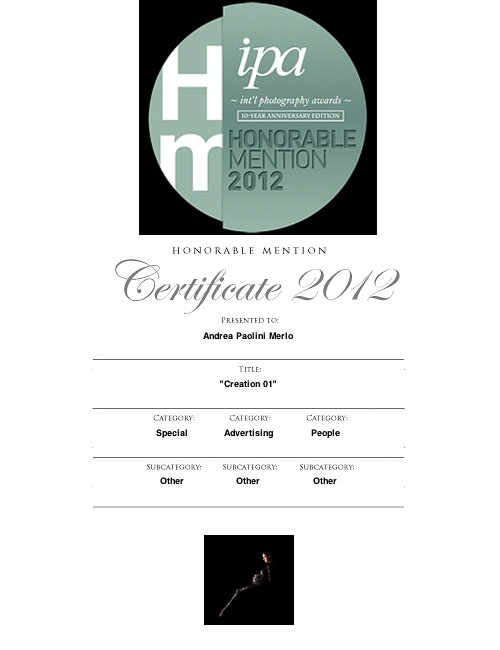
The 2012 International Photography Awards received nearly 18,000 submissions from 104 countries across the globe. IPA is a sister-effort of the Lucie Foundation, where the top three winners are announced at the annual Lucie Awards gala ceremony.
The Foundation's mission is to honor master photographers, to discover new and emerging talent and to promote the appreciation of photography. Since 2003, IPA has had the privilege and opportunity to acknowledge and recognize contemporary photographer's accomplishments in this specialized and highly visible competition. Visit www.photoawards.com.
|
|
August 2012 |
IPA 2012: Honorable Mentions
Andrea Paolini Merlo was Awarded in the IPA 2012 Competition with 2 Honorable Mentions in 2 different categories for the "SwansVision" entitled photo and Awarded with 2 Honorable Mentions in 2 different categories for the "Virginia Woolf" entitled photo.
ipa ~ int'l photography awards ~

The 2012 International Photography Awards received nearly 18,000 submissions from 104 countries across the globe. IPA is a sister-effort of the Lucie Foundation, where the top three winners
are announced at the annual Lucie Awards gala ceremony. The Foundation's mission is to honor master photographers, to discover new and emerging talent and to promote the appreciation of photography. Since 2003, IPA has had the privilege and opportunity to acknowledge and recognize contemporary photographer's accomplishments in this specialized and highly visible competition. Visit www.photoawards.com
|
|
July 2012 |
PX3 2012: Bronze Award
Andrea Paolini Merlo was Awarded Bronze in the PX3 2012 Competition.
PX3 PRIX DE LA PHOTOGRAPHIE PARIS
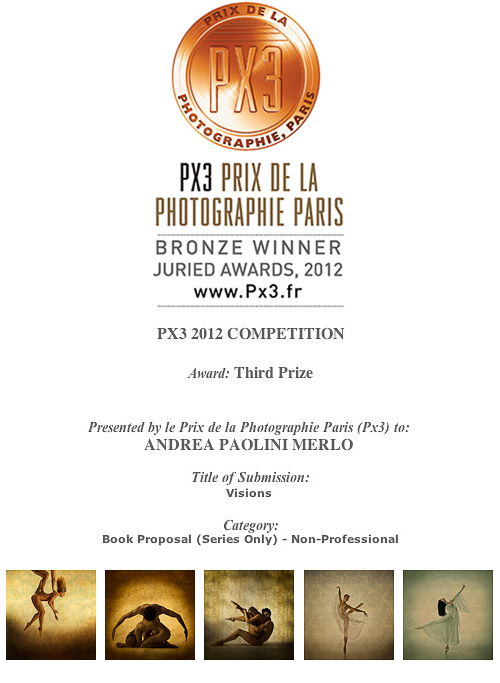
ANDREA PAOLINI MERLO OF HUNGARY WAS AWARDED THIRD PRIZE IN THE PX3 2012 COMPETITION.
PARIS, FRANCE
PRIX DE LA PHOTOGRAPHIE PARIS (PX3) ANNOUNCES WINNERS OF PX3 2012 COMPETITION.
Andrea Paolini Merlo of Hungary was Awarded: Third Prize in category Book Proposal (Series Only) for the entry entitled, " Visions ." The jury selected PX3 2012’s winners from thousands of photography entries from over 85 countries.
Px3 is juried by top international decision-makers in the photography industry: Carol Johnson, Curator of Photography of Library of Congress, Washington D.C.; Gilles Raynaldy, Director of Purpose, Paris; Viviene Esders,Expert près la Cour d'Appel de Paris; Mark Heflin, Director of American Illustration + American Photography, New York; Sara Rumens, Lifestyle Photo Editor of Grazia Magazine, London; Françoise Paviot, Director of Galerie Françoise Paviot, Paris; Chrisitine Ollier, Art Director of Filles du Calvaire, Paris; Natalie Johnson, Features Editor of Digital Photographer Magazine, London; Natalie Belayche, Director of Visual Delight, Paris; Kenan Aktulun, VP/Creative Director of Digitas, New York; Chiara Mariani, Photo Editor of Corriere della Sera Magazine, Italy; Arnaud Adida, Director of Acte 2 Gallery/Agency, Paris; Jeannette Mariani, Director of 13 Sévigné Gallery, Paris; Bernard Utudjian, Director of Galerie Polaris, Paris; Agnès Voltz, Director of Chambre Avec Vues, Paris; and Alice Gabriner, World Picture Editor of Time Magazine, New York.
|
|
June 2012 |
Kuala Lumpur International Photo Awards 2012: Top 30 in the "Open" category
Andrea Paolini Merlo's "InMotion 04" entitled photo was selected as best 30 pictures in the "Open" category at the 2012 Kuala Lumpur International Photo Awards.
Kuala Lumpur International Photoawards

Kuala Lumpur International Photo Awards 2012: Top 30 in the "Open" category
Andrea Paolini Merlo's "InMotion 04" entitled photo was selected as best 30 pictures in the "Open" category at the 2012 Kuala Lumpur International Photo Awards.
Kuala Lumpur International Photoawards
|
|
December 2011 |
Ballet News 2011 Photographic Competition: Winner
Andrea Paolini Merlo won the 2011 Ballet News Photographic Competition.
Ballet News
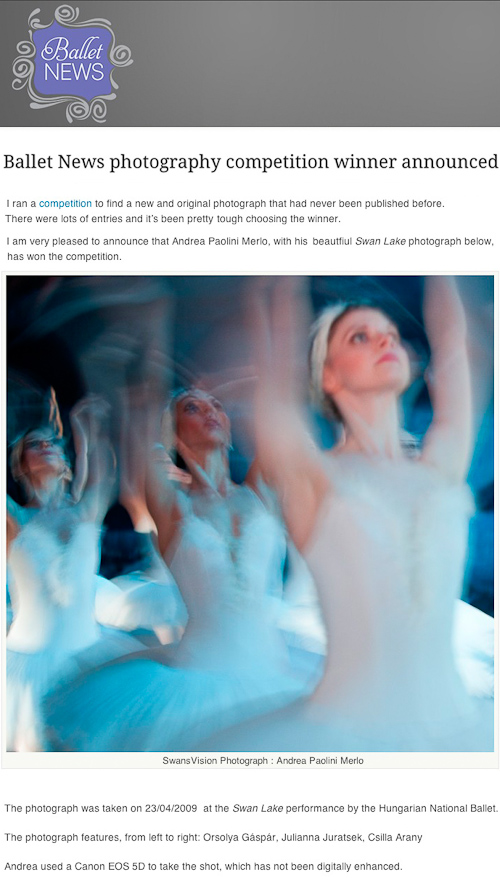
Ballet News 2011 Photographic Competition: Winner
Andrea Paolini Merlo won the 2011 Ballet News Photographic Competition.
Ballet News
|
|
August 2011 |
IPA 2011: 1st Place
Andrea Paolini Merlo was Awarded 1st Place in the IPA 2011 Competition.
ipa ~ int'l photography awards ~
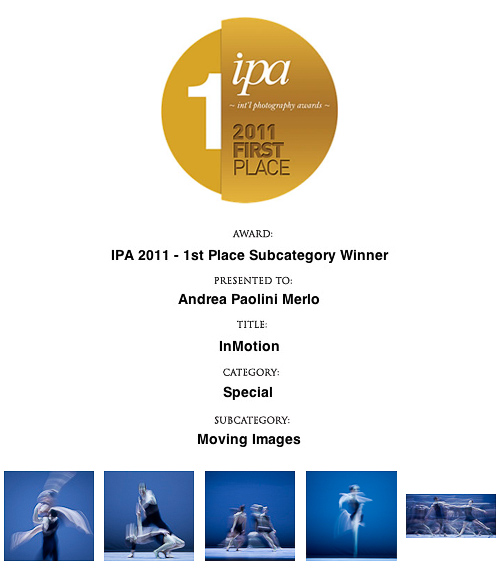
2011 International Photography Awards Announces Winners of the Competition
Andrea Paolini Merlo was Awarded: 1st place in Special - Moving Images category for the winning entry "InMotion"
About IPA: The International Photography Awards is a sister-effort of the Lucie Foundation, where the top three winners are announced at the annual Lucie Awards ceremony. The awards event will be held at the Lincoln Center in New York on October 24, 2011, before returning to Los Angeles in 2012 in celebration of the 10-year anniversary. Over 8,000 submissions from 90 countries were received for the 2011 International Photography Awards with over 70 jurors, the largest to date. The Foundation's mission is to honor master photographers, discover new and emerging talent, and promote the appreciation of photography. IPA is dedicated to recognizing contemporary photographers' accomplishments in this specialized and highly visible competition. Visit www.photoawards.com for more details.
|
|
June 2011 |
PX3 2011: Bronze Award
Andrea Paolini Merlo was Awarded Bronze in the PX3 2011 Competition.
PX3 PRIX DE LA PHOTOGRAPHIE PARIS
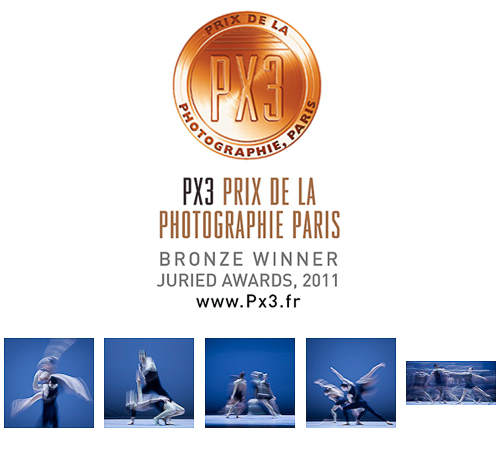
PRIX DE LA PHOTOGRAPHIE PARIS (PX3) ANNOUNCES WINNERS OF PX3 2011 COMPETITION. Andrea Paolini Merlo of Italy was Awarded:
Bronze in category Non-Professional Press for the entry entitled "InMotion".
The jury selected PX3 2011's winners from thousands of photography entries from over 85 countries.
Px3 is juried by top international decision-makers in the photography industry:
Alice Gabriner, World Picture Editor of Time Magazine, New York
Anna Zekria, Agency.Photographer.ru, Moscow
Arnaud Adida, Director of Acte 2 Gallery/Agency, Paris
Carol Johnson, Curator of Photography of Library of Congress, Washington D.C.
Chiara Mariani, Photo Editor of Corriere della Sera Magazine, Italy
Christophe Loviny, Independent Curator, Paris
Christine Ollier, Art Director of Filles du Calvaire, Paris
Daphne Angles Photo Editor NY Times, Paris
Daria Bonera Director, Daria Bonera Agency, Milan
Françoise Paviot, Director of Galerie Françoise Paviot, Paris
Janette Danel, Independent Curator, Paris Bernard Utudjian, Director of Galerie Polaris, Paris Jesper Thomsen, Director Mews42 Gallery, London Jerome Huffer, Photo Editor Paris Match, Paris Kenan Aktulun, VP/Creative Director of Digitas, New York Mark Heflin, Director of American Illustration + American Photography, New York Mike Bower, Managing Editor Sydney Morning Herald, Sydney Miriam Leuchter, Editor Popular Photography, New York Nan Oshin, Photo Editor Clark Oshin Gallery, Los Angeles Natalie Belayche, Director of Visual Delight, Paris Natalie Johnson, Features Editor of Digital Photographer Magazine, London Patrice Farameh, Publisher MAET Media, New York Patrick Kahn, Director SNAP! photo festival, Orlando Rebecca McClelland, Photography Director NewStatesman magazine, London Sara Rumens, Lifestyle Photo Editor of Grazia Magazine, London Susan Aurinko, Independent Curator, Chicago Susan Baraz, Curator, Co-chair Lucie Awards, New York Sherrie Berger, Director Scarlet works Creative Change Agency Viviene Esders, Expert près la Cour d'Appel de Paris
|
|
April 2011 |
Photo Exhibition at the National Dance Theater of Budapest
Andrea Paolini Merlo’s photographs of Balanchine’s ballet "Serenade"
® The George Balanchine Trust
National Dance Theater - Budapest

|
|
January 2011 |
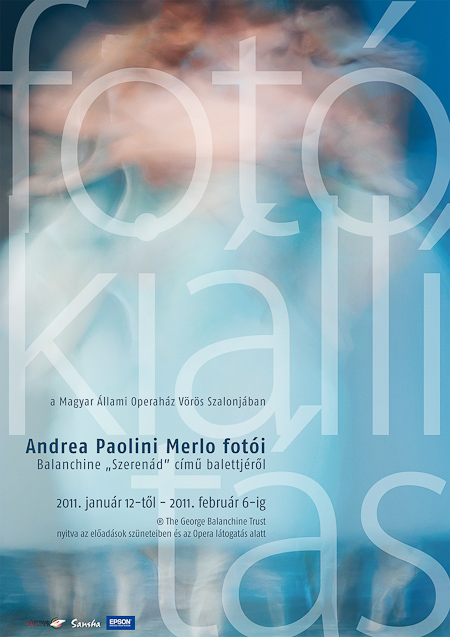
PHOTO EXHIBITION in the Red Salon of the Hungarian State Opera House
Andrea Paolini Merlo’s photographs of Balanchine’s ballet Serenade
from 12 January 2011 to 6 February 2011
® The George Balanchine Trust
Serenade
Serenade
was Balanchine’s first work in the United States and the first real symphonic
ballet. It is hard to believe the première was an examination performance at
the School of American Ballet. Balanchine used Tchaikovsky’s Serenade for String |
Orchestra for the
ballet. The spectacle is simple: in bluish light, the girls are wearing long
water-colour skirts which look more like training clothes than real costumes.
The first Serenade is about the ballet school and the dancing students, who had
just spent half a year in the newly opened school. They were not used to
dancing on stage, and their knowledge of ballet was varied. The first
performance was held in 1934, and the second one, already performed by artists,
in 1935. Today Serenade is an ever-glowing diamond in Balanchine’s oeuvre, and
ballet companies which have some self-esteem include Serenade in their repertoire.
The opening scene is already poetic: women are looking in the distance
as if they were saying farewell. Seventeen girls: Balanchine had exactly this
number of students for the performance. Other choreographers would probably
have simply left someone out so as to get an even number of dancers.
Balanchine, however, did not care: he arranged his dancers in diagonals of
various numbers of persons. The dancers form different geometrical forms, the corps de ballet breaks up into smaller
parts and then reunites only to let other groups break from it again. A female
dancer joins the others at the end of the first movement as if she had been
late. This is based on a real event, but Balanchine built it into the ballet in
a way that today’s spectators cannot imagine that it could have been composed
differently.
The first male soloist appears in the waltz of
the second movement, but the ballet is still about the female dancers, the
ballerinas. One of the most beautiful moments of the third, so-called Russian
movement – originally the fourth movement of the Serenade for String Orchestra – is the scene of the five female
dancers who are playing with space like a string of beads.
The last movement is dominated by darker tones. A couple walks through
the stage with the woman embracing the man, thus hiding the world from him.
They approach the front of the stage this way where they reach another woman
who is lying on the ground. This scene and the moving arms of the dancer at the
back justifies that she can be interpreted as the angel of destiny, and the way
the dancers slowly leave the stage in the closing scene and the stage gradually
darkens also makes us think of death.
Balanchine’s Serenade is miraculous even after
80 years: the impressive spectacle, which interprets Tchaikovsky’s Serenade for Strings poetically using the language of dance. The geometrical forms are composed perfectly, and the whole ballet is full of brilliant ideas, and still it is simplicity and sophisticated grace. Balanchine was often asked to tell what his ballet was about, but he rejected all assumptions. In his interpretation it was simply about women dancing in the moonlight
George Balanchine
(1904-1983)
He was undeniably one of the greatest figures of
20th century dance. Being of Georgian descent, he studied at the St.
Petersburg ballet school, but was unable to decide whether to become a musician
or a dancer for a long time. His talent in choreography became evident before
his graduation, but it began to blossom when he was working with the Russian
Ballet in Western Europe (1924–1929). Commissioned by Sergei Diaghilev, he
established contacts with a number of outstanding composers (Stravinsky,
Prokofiev) and artists (Derain, Utrillo). Compositions in this first period
include Apollon Musagètes and The Prodigal Son.
1933 brought a major change in his life when he
accepted American arts patron Lincoln Kirsten’s offer to move to the United
States. Moving there meant that he had his own school, and, not much later, his
own company where he could put all his ideas into practice without making
concessions. In the beginning audiences in the New World were not very
enthusiastic about his pieces without stories, but the situation of his ballet
became so firm after World War II that his company, which was known as the New
York City Ballet from 1948, soon became the leading ballet company in this vast
country. Balanchine remained the leader of his company until his death, and
today he is regarded as the founder of American ballet and an epoch-making
genius.
Balanchine’s company employed a number of
well-trained dancers who had graduated from his school, and they achieved great
successes with their master’s so-called symphonic ballets. Balanchine’s oeuvre
contains more than three hundred of such pieces in which the emphasis is on the
relationship of music and dance, as they were composed to symphonic music with
the aim to interpret either the structure or the mood of the music, or
sometimes both. In all cases the choreographer uses the structure of the music
as a base, for example the competition and construction of instrument groups or
solo instruments. Thus, the symphonic ballet transforms the music which can be
heard from the pit to dance. All the ballets of this genre lack plots, and sets
and spectacular costumes are often omitted too. The reason behind this is that
the spectacle of the piece should not divert the attention from the organic
unity of music and dance. As regards style, Balanchine’s pieces are
neo-Classical, because after the inventive, often acrobatic and sometimes even
grotesque movements of his early years, the choreographer returned to the 19th
century elements of Classical ballet, but he used these in an aesthetic way and
not in compliance with the Classical canon.
All the photos on display are for sale.
The funds raised by the sale of photographs
will be transferred to the account of the Hungarian National Ballet Foundation.
The Foundation will use the funds to support young dance talents and premières
of new productions.
|
|
June 2010 |
PX3 2010: Honorable Mention
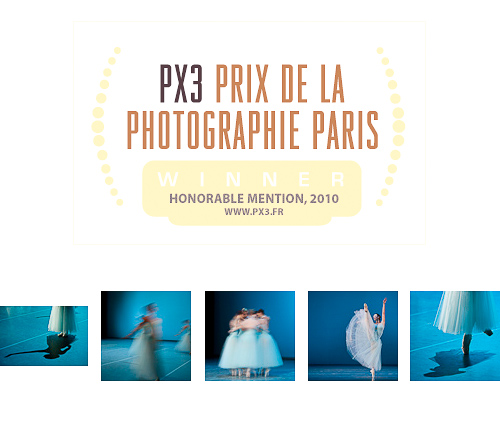
Andrea Paolini Merlo was Awarded in the PX3 2010 Competition.
PX3 PRIX DE LA PHOTOGRAPHIE PARIS
PARIS, FRANCE
PRIX DE LA PHOTOGRAPHIE PARIS (PX3) ANNOUNCES WINNERS OF PX3 2010 COMPETITION.
Andrea Paolini Merlo was Awarded:
Honorable Mention in category Non-Professional Photojournalism/Performing Arts for the entry entitled "Shades".
The jury selected PX3 2011's winners from thousands of photography entries from over 85 countries.
Px3 is juried by top international decision-makers in the photography industry: Carol Johnson, Curator of Photography of Library of Congress, Washington D.C.; Gilles Raynaldy, Director of Purpose, Paris; Viviene Esders, Expert près la Cour d'Appel de Paris; Mark Heflin, Director of American Illustration + American Photography, New York; Sara Rumens, Lifestyle Photo Editor of Grazia Magazine, London; Françoise Paviot, Director of Galerie Françoise Paviot, Paris; Chrisitine Ollier, Art Director of Filles du Calvaire, Paris; Natalie Johnson, Features Editor of Digital Photographer Magazine, London; Natalie Belayche, Director of Visual Delight, Paris; Kenan Aktulun, VP/Creative Director of Digitas, New York; Chiara Mariani, Photo Editor of Corriere della Sera Magazine, Italy; Arnaud Adida, Director of Acte 2 Gallery/Agency, Paris; Jeannette Mariani, Director of 13 Sévigné Gallery, Paris; Bernard Utudjian, Director of Galerie Polaris, Paris; Agnès Voltz, Director of Chambre Avec Vues, Paris; and Alice Gabriner, World Picture Editor of Time Magazine, New York.
|
|
|
|
|